
Tonight I got one of the best assignments I've so far received writing for Tilzy.tv (My review is now up here); I got turned onto Sixty Symbols. A project by Brady Haran, filmmaker-in-residence at Nottingham Science City, Sixty Symbols is a series of short primers that explain the significance of some of the most important concepts in physics and astronomy. Let me tell you it's absolutely fascinating and completely brilliant. At the moment I've only had the time to watch a few of these (and there are still more being produced), but I'll be spending an inordinate amount of my upcoming free time checking the rest out.
To get a taste watch this one one Jupiter:
Showing posts with label science. Show all posts
Showing posts with label science. Show all posts
01 July 2009


23 February 2009
BRAINS!
Not sure if this is from today or last week, but Scientific American posted a list of a few things individuals can do to boost their brainpower, even later in life. Tabloid magazines publish this kind of stuff all the time, but SciAm being SciAm, this list is far more interesting. Among the things that aren't exercise or meditation (both kinda boring) are:
* Drink coffee and eat blueberries. That's fantastic news, because I just ate a blueberry muffin with my morning coffee. Actually what they say is eat your fruits & veggies (duh) and cut back oh saturated fat (also duh). Stimulants can also boost brainpower, though cocaine and amphetamines are not the preferred choice (also also duh). SciAm would also like you to, "[t]ry to limit yourself to fewer than 100 cups a day. That much coffee contains about 10 grams of caffeine, enough to cause fatal complications."
* Play video games. No joke, this is #4 on the list. I don't really play, but most of my friends do, so that should make them feel smarter (despite all evidence to the contrary). Playing video games has been shown to "improve mental dexterity, while boosting hand-eye coordination, depth perception and pattern recognition."
* Listening to music. I would add playing music to this list as well as qualifying what counts as "music". Listening to top-40 radio is not going to make you smarter though it has been shown to make people's personalities far more banal. Also, that Mozart-in-the-womb theory has been discredited, although listening to his Requiem should be mandatory for all humans. As far as music making people smarter, I recommend jazz, math rock, tech-y metal, modernist composition, and Beethoven.
18 February 2009
Homo Evolutis
This talk is beyond fascinating; the implications of Enriquez's predictions are sure to cause a minor tempest in the coming months and years. Also, he has nearly the same voice as Thomas Lennon, which is mildly disorienting.
28 January 2009
Video, Or It Didn't Happen
"We had this patient who suffered penile fracture after running across the room and trying to penetrate his wife with a flying leap."
That such a scenario could even occur has just completely blown my mind.
That such a scenario could even occur has just completely blown my mind.
06 January 2009
Brains & Competition
Yesterday, Jonah Lehrer (of Seed Magazine) posted a great find from The Boston Globe's "Ideas" section about brain functioning under different competitive scenarios. It appears that humans retain their competitive nature only up until a point and that when a group becomes too large to be competitive within, the brain essentially shuts itself down.
In one study researchers observed different sized groups taking test like the SATs and found that in small groups students performed much better than those in large rooms with many other test-takers. It appears that when in small groups, a participant is able to better size up their competition. Test-takers who were housed in a large room had lower scores, presumably because they were overwhelmed by the amount of competition they were up against.
An unrelated study looked at similar phenomena from a different angle. In a supermarket a display of jams was set up for customer taste-tests. When only 6 competing jams were used, sales increased among the products displayed. Then, when 30 different jams were displayed for the same purposes, people basically wanted nothing to do with them. There was such an array of choice that their brains short-circuited attempting to make any sort of decision. However, the study also found that when products were placed into categories—however arbitrary—people had a much easier time choosing a product or making a decision.
These findings seem completely plausible to me judging by my own behavior as well as what I've seen in my non-scientific daily observations. Give people small groups in which to operate and they find it much easier to orient themselves. I know in dealing with music, as seemingly arbitrary as "categorizing" bands and sounds can be, it is really helpful for our brains. Providing a label creates a foundation from which to analyze and associate; from that beginning one can make all sorts of further connections and establish their own web of knowledge. If you were to take a random assortment of bands and have someone start picking out the "best" (for lack of better example) bands in that pile, that person would have a panic attack. But if you had them organize that pile somehow and then pick out certain elements, they'd have a much easier time.
As far as competition goes, some commenters wondered how professional athletes (as one example) operated on such a high level in the face of this research. I contend that the best of the best don't even consider most other humans viable competition, and thus render them out of the picture. From a young age they've most likely—and clearly I'm assuming here—picked out a few other talented individuals against whom they could compete on a high level. At each stage (high school, college, pro, etc.) the categorizations of who matches their skill is refined. I think the same could be said of any endeavor, whether it's basketball, soccer, painting, poetry, furniture design, gardening, politics, etc. Folks who engage in these activities who have a desire to be good at them always find markers against which to measure their competition.
Back to the original point of the study, although this kind of competition in humans appears obvious, I think it's great that science has shown it to be an observable phenomenon and non just some folksy, anecdotal thing. Also, the fact that there are clear limits to the efficacy of competition amongst individuals is a great thing. Now, when some economists come along and make the claim that more and more actors in a market is good, we have this evidence to back up the counter-argument. Some competition is a marvelous thing, too much competition is a waste of everyone's time.
16 November 2008
John D. Barrow—New Theories of Everything

Back in early June, I had made note of some thoughts I had (yeah, it happens) about the search for a "Theory of Everything". I try to keep abreast of current work in cosmology and high-energy physics, particularly if new work appears that's crafted for the education of the layman, "because that's who I am, and that's who I care about." Anyhow, I made the notes regarding the nature of what a theory of everything actually is. Fundamentally, it's a religious pursuit undertaken by ostensibly secular physicists and mathematicians. Why do I call it a religious pursuit? Mainly because in order to reduce the workings of the universe to a comprehensible, elegant mathematical function one must know far more than I think we're capable of understanding (i.e.; initial conditions for the grand event that birthed our universe).
Now there are reasons why I don't think we can know these, and that's where Cambridge mathematician/cosmologist John D. Barrow comes in. New Theories of Everything is an update of a book he wrote in 1991 and provides incredibly clear explanations for a vast array of mathematical and cosmological concepts. (As in frightening, geniusesque clarity.) It's exactly the high-end pop-science book I've needed to read for a while, because while Barrow's grasp of physical phenomena is tight, his deep knowledge allows him to be critical of certain directions many of his peers are taking.
The main premise of the book revolves around the idea that there is no reason to think that the physical properties of our universe can be distilled into one mathematical function. While our universe may have a mathematical skeleton, there are many aspects of its existence that are chaotic and non-linear and other aspects (think closer to home à la the arts) that don't seem to have mathematical explanations at all. Without knowledge of the exact states of initial conditions of these chaotic phenomena we have no way of predicting how future states will turn out (thus negating the ability to confirm the accuracy of an equation or experiment). Symmetry breaking also gives theorists headaches for similar reasons, but I just mangled that last explanation so I'll leave this one for the expert (read the book) to flesh out.
Lastly, I must mention—and I'm cutting this review off because I'm obviously not a physicist and I've also been enjoying some scotch—this book left me a bit baffled. Not by the content per se, as it was expertly explained and I highly recommend reading it, but by the author himself. You see John D. Barrow is a religious man, of a specific christian denomination. Now it may be obnoxious of me to go down this path, but after reading such an obviously brilliant explanation of some of the most conceptually difficult material for humans to comprehend, I cannot help but wonder how its author holds such traditional christian beliefs (i.e.; that jesus our savior, the viability of the trinity, etc.) and is able to reconcile them with all he knows of our universe—not to mention the possibility of an infinite multiverse of which our universe is only one small bubble. I find this realization more troubling and difficult to comprehend than the ideas of infinity or nothingness. But maybe I'm the weird guy.
Anyway, regardless of my ever-dyspeptic responses to the continuing presence of nonsensical religious beliefs in today's world, read this book if you have any interest whatsoever in quantum phenomena, chaotic systems, universal origins, multiverse theory, string theory and any aspects of mathematics. The latter almost always forms a stumbling block for laypersons and Barrow's ability to explain various mathematical concepts made me want to strangle all the terrible math teachers I had growing up who never explained a single fucking thing.
fin.
07 October 2008
All Of These People Just Watched That Debate
These are easily some of the gnarliest medical "cases" I've ever seen; posted over at the Neurophilosophy scienceblog. As they say, "An x-ray is worth a thousand units of indecipherable medical jargon."
Watch yr melon, buddy!
Watch yr melon, buddy!
Cellphone Popcorn
Update: I posted this video without conducting due dilligence. Apparently what follows was busted on Mythbusters at some point and does not work. Now I want to know how they staged these videos...
* * * * *
My dad just sent me this and it's awesome. Know how much radiation your phone gives off when it rings? Well, enough so that...aw just watch the video...
Luckily I keep my cellphone away from corn and in my pocket next to my...oh...
* * * * *
My dad just sent me this and it's awesome. Know how much radiation your phone gives off when it rings? Well, enough so that...aw just watch the video...
Luckily I keep my cellphone away from corn and in my pocket next to my...oh...
16 August 2008
Hey Newton...Suck It!
This video is footage of a ferromagnetic liquid manipulated through the use of electromagnets. What follows isn't CGI or digitally altered, it's the real deal: artwork created by Japanese physicist Sachiko Kodama in experiments using magnetic particles suspended in oil. More info and links here.
05 August 2008
Bill and Ted (Two Different Ones)
Last night before band practice I was hanging out at my drummer's place and a few of us were watching some tv documentary on the Unabomber, Ted Kaczynski. To make a long story short, the Unabomber was considered "crazy" and labelled a "paranoid schizophrenic" (which I can't necessarily disagree with) because of his ideas and methods. Clearly, the show was biased in a manner that wished to reflect modern society as a positive thing and, despite showing pictures of smog and polluted streams, they failed to give an accurate representation of criticisms of industrial society. Frankly, I'm not shocked.
Now, most reasonable people will take issue with Ted Kaczynski's methods, as they certainly reflect his inability to socialize with other humans. However, many of his ideas about technological society hold water and continue to resonate today. When I got home from practice I decided I should read the whole Unabomber Manifesto, but I got distracted by another article I found. This one was by Bill Joy, Chief Scientist at Sun Microsystems, and featured in the April 2000 issue of Wired magazine. In the article he describes how he was confronted by some of the salient issues brought up by Kaczynski and his own role in the progress of technology. A particular focus of the article are the ideas of futurist Ray Kurzweil and his book, The Age of Spiritual Machines. (Since this article's publication Kurzweil has published another book, The Coming Singularity, whose premise I find absolutely horrifying and, given Joy's take on the earlier work, I think he would as well.)
As I think I've mentioned at other times on this site, I'm a supporter of scientific endeavor and not a complete Luddite, but I have qualms with those who view technology as a panacea for our societal and environmental ills. Technology doesn't solve our problems, it just changes them. For every problem solved a new one arises that did not exist previously. Making a new gadget makes life more complicated, it doesn't make it easier or safer. Things may get more interesting, but our fundamental questions remain the same (and in this respect I understand why people would follow religions, however ridiculous in premise). Call me a daoist, but I think that over the long haul, everything balances out even if it means extreme reactions (natural or artificial) become the force behind that shift.
Anyway, I'm rambling cos I'm at work and this is all off-the-cuff. I highly recommend reading Bill Joy's article and taking in what he says in there. Tonight my plan is to read the Unabomber Manifesto and put together some kind of response to that on here.
29 July 2008
Drunk Animals In Malaysia
Not long ago I mentioned that I wanted to find these videos of rubber-tapping in Malaysia. Well, scientists have done me one better and discovered some boozy tree-shrews there instead. These little fellas consume copious amounts of fermented palm nectar, a beverage that rivals beer for alcohol content. Unfortunately, the scientists (they're German, so they know about which they speak) did not discover any signs of inebriation. They claim it doesn't make sense for animals, evolutionarily speaking, to become intoxicated.
I contentiously beg to differ on that last point.
Read here
&
Read here
I contentiously beg to differ on that last point.
Read here
&
Read here
10 July 2008
I Like Science. A Lot.
noga: personally i like the phrase - knee deep in pussy
(note to any future female suitors: I still may have trouble with your bra clasps. Consider yourself warned)
but thats also kinda gross
and usually impossible
Sent at 2:17 PM on Thursday
me: yeah, that's kinda gross
noga: hahah
me: i wouldn't mind a nice dry hump on my leg, though
noga: eeeeew
me: it'd be like high school, or a second date
noga: yeah
young love!
i remember those..
me: ah, how romantic
having no idea what the fuck you're doing
kissing sloppily and poorly
noga: yeeeeahhh
me: bra clasps from hell
those were certainly awkward days
Sent at 2:23 PM on Thursday
noga: thankfully girls in williamsburg dont wear bras anymore
Sent at 2:25 PM on Thursday
me: well, i'm willing to do the research personally and make sure that is a factual statement
Sent at 2:26 PM on Thursday
noga: you're so kind and selfless
a saint, really
me: it's all in the name of science
noga: i'm willing to match your research
me: to find guys who don't wear bras?
noga: by looking into whether guys with super tight pants actually have penises in there
me: zing
noga: (current theory: no)
me: yeah, i'm also intruigued, but not interested in touching
noga: don't worry, i'll do the touching
you just sttand there with a clipboard and take notes
me: how can i possibly hold a clipboard with my hands (hopefully) full of boob
(just so you know, this segment of our conversation is clearly going to my blog)
Sent at 2:30 PM on Thursday
noga: dude we're not going to conduct our experiments AT THE SAME TIME
we're going to monitor each other's experiments
cuz your analytical skills will be that of a retarded child when you're busy grabbing boobs
you need an object indifferent partner
objective even
man this whole typing words thing is harder than it used to be
me: sorry, i was distracted by boob thoughts
noga: i rest my case
(gross)
(note to any future female suitors: I still may have trouble with your bra clasps. Consider yourself warned)
03 July 2008
Jill Bolte Taylor: Stroke of Insight, Stroke of Genius
If any of you readers are unfamiliar with TED, make yourself familiar now. It's a site replete with incredible short lectures that will simply blow your mind. I just finished watching one for which everybody should put their lives on pause for the not-quite-20 minute duration. No sense in me rambling on about this now, my left brain hemisphere is taking some time off to let my right hemisphere do its thing. Just watch:
28 May 2008
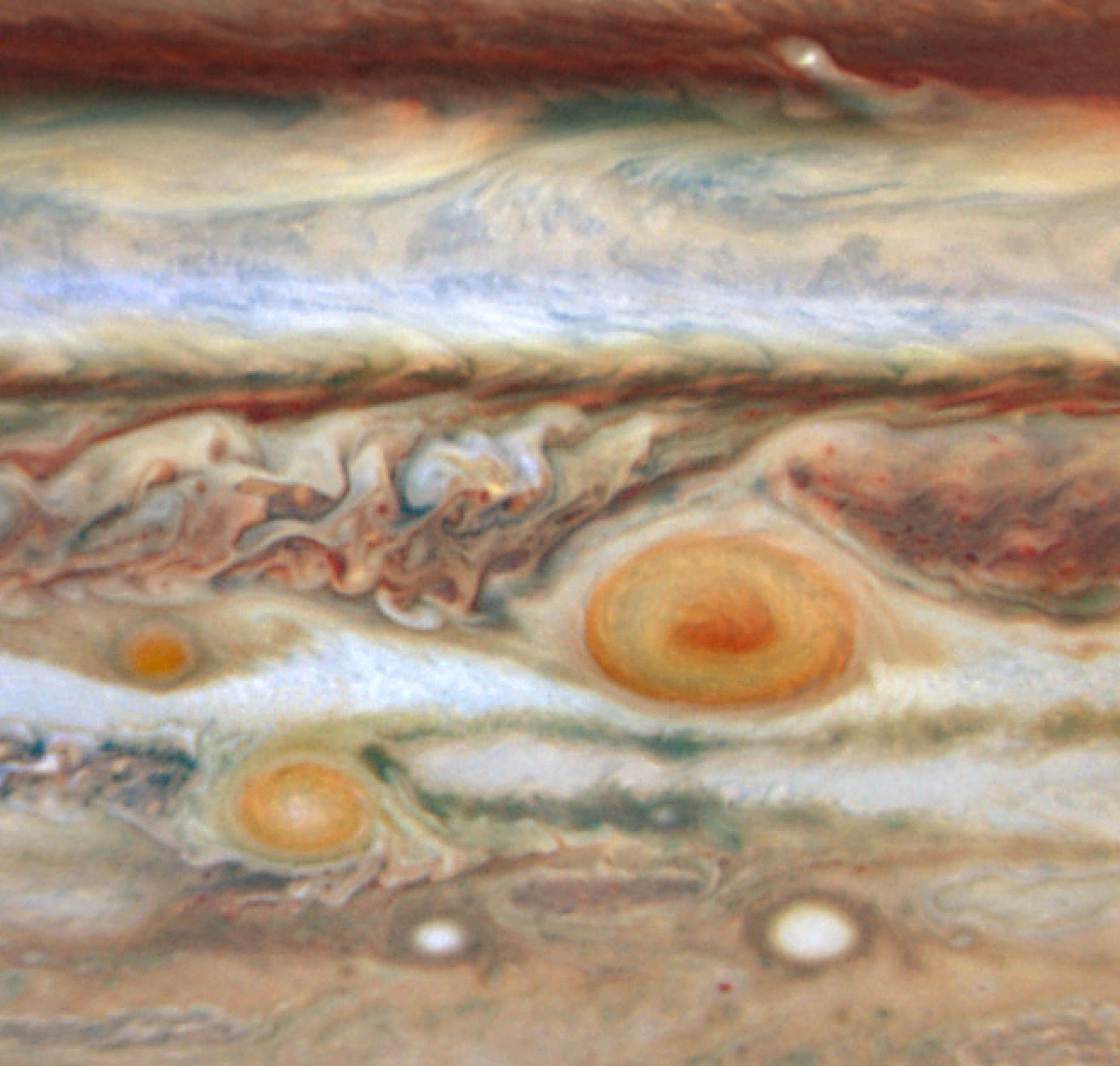
Meanwhile, Jupiter Suffers Break-Out Just In Time For Summer
I'm not sure most people realize how large Jupiter is. (I'm also not sure people really understand how large Earth is, either, but that's a completely different topic.) Anyway, Jupiter has developed two new giant storms near its famous "Great Red Spot". Just so you're all aware, the Great Red Spot is more than two Earth diameters across. Apparently if the little one that sits in the same band continues to move toward the Big Guy they will collide sometime in August. I'm so excited about this.
26 May 2008
Memorializing Science
Today is Memorial Day here in the US, but as I'm not much for the military, I found something else more worthy of memorializing: scientific thought and inquiry. So for all you nerds out there, especially those of you who are all inked-up, I found something awesome. Science writer Carl Zimmer (who I'm assuming does not have any tattoos) has a gallery of science-related tattoos that people have sent in. Some are simple, others incredibly complex. Regardless, it's a great gallery with explanations from the inked themselves.
25 April 2008
Yowzers! (Weak Stomach Alert!)
This is amazingly gross. I feel terrible for this girl. She looks like an elephant seal and it may kill her...
Scientific American will put you in the mood.
Scientific American will put you in the mood.
09 April 2008
See the pretty notes, taste the chord progressions
I've been working on a piece about synaesthesia, which is, for those who don't know, a neurological condition that creates 'crossover' effects in experienced sensations. The most common form of this exists in those for whom letters and numbers have related (and specific) colors. There are musical variants that have colors related to certain keys or notes or even different chord progressions. I don't dare call it an 'affliction' because that has negative connotations and this does not sound negative in any way. In fact, it is reported that the vast majority of synaesthetes would hate to lose such a 'gift' and I could hardly disagree with such a statement. I'm actually kind of jealous, to be honest.
There are all sorts of artists who have this and probably loads of non-artist people, too. It is thought that 1 in 23 people have one of at least 54 different forms of the condition. I've mostly focused on musicians and composers who have it. Among them are Richard D. James (Aphex Twin), Duke Ellington, Eddie Van Halen (apparently dickheads can have it, too), Jean Sibelius, György Ligeti, Nikolai Rimsky-Korsakov and Olivier Messiaen. Below is a video (I don't know from when, but it looks a bit dated) of a Messiaen piece that is pretty rad. He saw different colors as keys changed, was a trained ornithologist and also a convert to Catholocism. I figure that's a pretty full life.
There are all sorts of artists who have this and probably loads of non-artist people, too. It is thought that 1 in 23 people have one of at least 54 different forms of the condition. I've mostly focused on musicians and composers who have it. Among them are Richard D. James (Aphex Twin), Duke Ellington, Eddie Van Halen (apparently dickheads can have it, too), Jean Sibelius, György Ligeti, Nikolai Rimsky-Korsakov and Olivier Messiaen. Below is a video (I don't know from when, but it looks a bit dated) of a Messiaen piece that is pretty rad. He saw different colors as keys changed, was a trained ornithologist and also a convert to Catholocism. I figure that's a pretty full life.
08 April 2008
Cablevision Sucks (as if you weren't aware)
Finally.
After two no-shows last week and a near third today, Cablevision finally arrived to provide my new apartment with an internet connection (of course, they had to botch something so they apparently disconnected the upstairs neighbors! uh-oh...). I don't know if anyone has ever had to deal with these morons, but obviously they are not competent service providers. Unfortunately for me, they have the monopoly over my Bushwick zip code, so I have no choice but to go with them. Cablevision...Cablevision...YOU SUCK!

On an awesomely positive note (that I should probably separate from the above nonsense but won't), I have to give two thumbs up to Liz Hazelton at Random House. She's none other than the publicist for Michio Kaku's latest book Physics of the Impossible and she caught my last post about his other books. Liz was gracious enough to send me a copy 'on the house'. Sweet move 'cos that just means more publicity! Also, in case anyone missed it yesterday, Mr. Kaku was on the Leonard Lopate Show on WNYC, so there's the link to go listen to them talk about cool stuff.
Anyway, welcome back to my dear, dear heart, Internet. Now I can get work done and do my taxes...
31 March 2008
Now, More Internet @ Work!
Sorry I haven't been posting about anything lately. I've been hard at work on a few projects and, with my move to my new apartment completed, I now lack internet until it gets set up there. On the upside, we have a newly connected computer at work, so I can kill bits of the fourth dimension just like I'm doing right now.
Speaking of dimensions, I'm a bit pissed because I was about halfway through Michio Kaku's Parallel Worlds when somebody stole that book from the store! Fuck you, thieves! So in it's place I started to read Kaku's previous book, Hyperspace. Figures people would buy both copies in the space of a week. So now I have no Kaku!
Now back in college we used to do a bit of thievery, which I don't condone, but I know folks do it. Thieves make me feel old and crotchety now. Humbug, you swine! I want to read about higher dimensions and here you are swiping paper! Then again, by the oddities of quantum mechanics, the book may have just disappeared into another dimension or somewhere else in our universe in a wormhole of sorts. Highly unlikely, but still possible, nonetheless.
17 March 2008
This ain't so bad at all!
Sorry I haven't posted anything in the past week or whatever (if it even matters). But I've found some really great stuff while glued to my laptop in the endless pursuit of knowing more things than I knew yesterday and then writing about them for money.
1. I wrote a long piece based on all the Turgenev/Nihilism/Postmodernism stuff I rambled about not too long ago. Because of that research I discovered that I was right about many aspects of "postmodernism" (ie; it's not really a coherent thing at all), but also that I was a bit closed-minded about it and there are some writers whose stuff I really appreciate. One of them is Richard Rorty. When I first was exposed to some of his ideas I thought they were reprehensible. Of course, when I read the interviews with him gathered in Take Care of Freedom and Truth Will Take Care of Itself, I realized I agreed with an incredible amount of pragmatist and antifoundationalist thought. It also germinated a drive to recast elements of nihlism in a more positive light (though that's a really long-term project, I guess). You can get a good idea of where my brain might be after reading the essay through which I was exposed to Rorty's ideas. Now I don't necessarily agree with everything in the essay, but I don't think I have to agree with anything. Necessarily.
2. Tonight I finished an article on string theory and cosmology that was exhausting to research. Fortunately I found a great guide to help me out and give me some focus. A couple months ago I waddled my way through Brian Greene's The Elegant Universe and enjoyed it despite not really understanding a whole lot of what was going on. Thankfully, PBS made a three part documentary based on the book that makes a fantastic companion! The whole thing is streamed here in segments which make it way more manageable to watch. It also makes it a hell of a lot easier to watch a part again if you didn't understand it the first time. I had to do that a few times.
3. After this week I'll hopefully be able to return to posting a bit more regularly. I just have a bunch of material to submit in a short time. Since I have no idea when the site I'm writing for is going to be up and running, I may post more excerpts and links to keep any readers updated on things. Also, if any of you haven't yet, go check out some of my friends' blogs. A few of them (here, here & here) have been contributing material to the same website and I think the product will be incredibly interesting (I'll keep everyone updated when it finally goes online).
1. I wrote a long piece based on all the Turgenev/Nihilism/Postmodernism stuff I rambled about not too long ago. Because of that research I discovered that I was right about many aspects of "postmodernism" (ie; it's not really a coherent thing at all), but also that I was a bit
 closed-minded about it and there are some writers whose stuff I really appreciate. One of them is Richard Rorty. When I first was exposed to some of his ideas I thought they were reprehensible. Of course, when I read the interviews with him gathered in Take Care of Freedom and Truth Will Take Care of Itself, I realized I agreed with an incredible amount of pragmatist and antifoundationalist thought. It also germinated a drive to recast elements of nihlism in a more positive light (though that's a really long-term project, I guess). You can get a good idea of where my brain might be after reading the essay through which I was exposed to Rorty's ideas. Now I don't necessarily agree with everything in the essay, but I don't think I have to agree with anything. Necessarily.
2. Tonight I finished an article on string theory and cosmology that was exhausting to research. Fortunately I found a great guide to help me out and give me some focus. A couple months ago I waddled my way through Brian Greene's The Elegant Universe and enjoyed it despite not really understanding a whole lot of what was going on. Thankfully, PBS made a three part documentary based on the book that makes a fantastic companion! The whole thing is streamed here in segments which make it way more manageable to watch. It also makes it a hell of a lot easier to watch a part again if you didn't understand it the first time. I had to do that a few times.
3. After this week I'll hopefully be able to return to posting a bit more regularly. I just have a bunch of material to submit in a short time. Since I have no idea when the site I'm writing for is going to be up and running, I may post more excerpts and links to keep any readers updated on things. Also, if any of you haven't yet, go check out some of my friends' blogs. A few of them (here, here & here) have been contributing material to the same website and I think the product will be incredibly interesting (I'll keep everyone updated when it finally goes online).
Subscribe to:
Posts (Atom)


